
Advocates cannot advertise, but they can be found. This guide sets out the ways practices are really built in India, what the rules allow online, how to turn an enquiry into a client, and where a client-initiated platform fits.
Every senior advocate has a version of the same story. Years of carrying files for someone else, standing in court for adjournments, drafting at midnight for a senior's matter listed the next morning, and very slowly becoming the person colleagues and clients thought of first. That path still exists and still works. What has changed is how many people are walking it, and how few of them start with a family chamber to inherit.
A large share of advocates entering practice today are first-generation lawyers. They often come from smaller towns, graduate with loans, and join a senior who may or may not pay them. In October 2024, the Bar Council of India issued guidelines suggesting that junior advocates be paid a stipend of at least Rs 20,000 a month in urban areas and Rs 15,000 in rural areas. The guidelines are advisory, not binding, and High Courts in Madhya Pradesh, Delhi and Punjab and Haryana have also heard pleas about juniors' pay. The very fact that this needed saying shows how thin the early years can be.
At the same time, the way clients find lawyers has shifted. People still ask relatives and neighbours first, but a growing number start with a phone search, frequently after dark and frequently somewhere they have no lawyer friends to ask. They meet a confusing world of directories, call centres and paid listings. Many of these are exactly what the Madras High Court and the Bar Council of India have criticised since 2024.
So an advocate today has two jobs at once. Build the old-fashioned reputation that brings referrals, which takes years and cannot be bought. And make sure that people who need you can actually find you, without crossing the line the Bar Council rules draw. This guide is about both.
Before deciding where to put your energy, it helps to see the client's side. Most people who need a lawyer have never hired one before. They are anxious, short of time and often embarrassed. Their search usually runs through a predictable sequence.
Two more things shape the search. Urgency: a person whose relative has just been arrested, or whose cheque bounce deadline expires on Friday, will hire the first competent advocate who answers. Language: many clients, particularly older people and those outside the big cities, search for an advocate who will explain things in Hindi, Marathi, Tamil, Bengali or their own language, and they feel an immediate sense of relief when they find one. Neither of these is about marketing. Both are about being reachable and understandable.
Three lessons follow. First, your existing clients and colleagues are your strongest source, because the first step runs through them. Second, being genuinely findable online in a permitted way matters more each year, because the third step is growing. Third, the moment that decides whether a person becomes your client is the first conversation, not the profile they found you on.
Rule 36 of the Bar Council of India Rules bars an advocate from seeking work or advertising in any form: no circulars or advertisements, no touts, no personal approaches that are not justified by an existing personal relationship, no planting of newspaper comment, and no photographs published in connection with cases. The 2008 amendment carved out one exception, a website showing your name, how to reach you, your enrolment, your qualifications and the kind of work you do.
Related rules matter as much. An advocate should not use touts or pay anyone for bringing work, should not share fees with people who are not advocates, and should not permit their name to be used to promote unauthorised practice. Professional misconduct can be punished by the State Bar Council under Section 35 of the Advocates Act, 1961, with penalties up to suspension or removal from the roll.
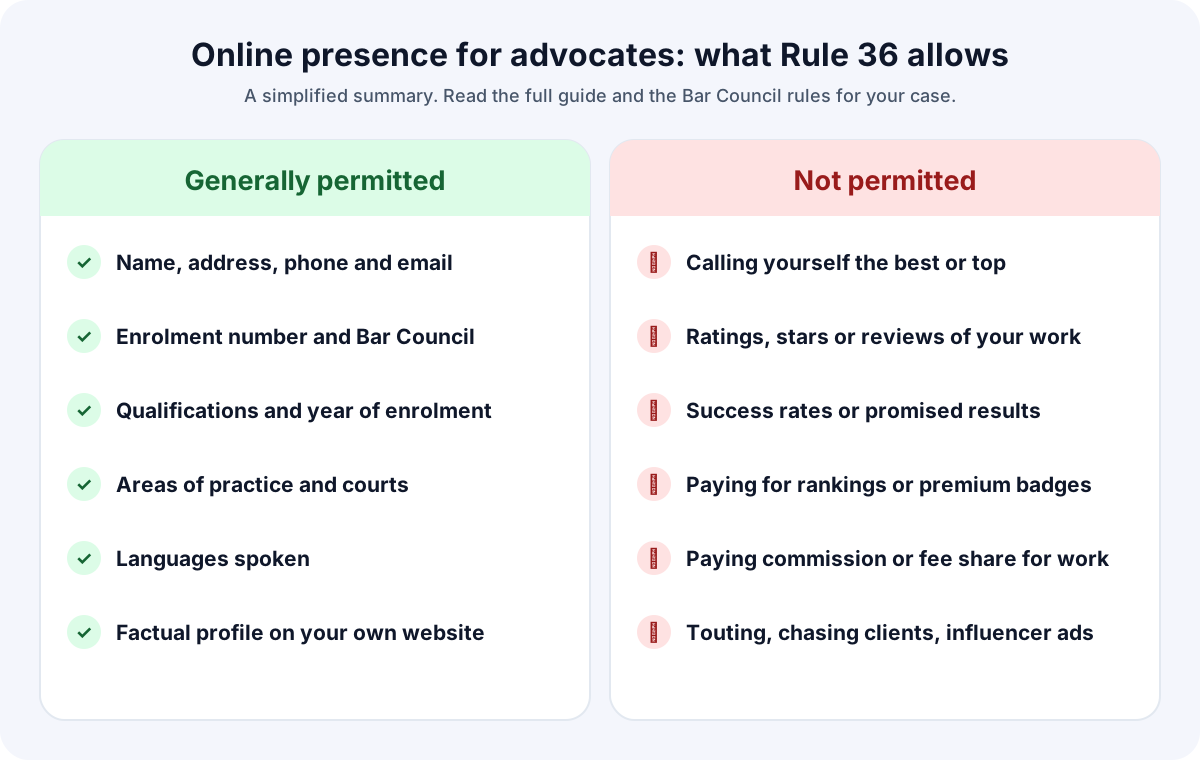
In 2024, the Madras High Court held that lawyer listings with ratings and "premium" badges on directory sites amounted to facilitating advertisement, and the national Bar Council followed by directing state councils to take disciplinary action where advocates sought work through online portals. During 2025 the national Bar Council, and separately the Bar Council of Delhi, cautioned advocates against promotional videos, celebrity and influencer tie-ups and touting for work on social media. A broader question about online listings is pending before the Supreme Court. Our detailed guide, Can advocates advertise in India?, explains each development.
None of this stops you from building a practice. It decides the methods. Every source below is chosen with these rules in mind.
These are the ways Indian practices are actually built. Few advocates use all of them. Pick the ones that suit your city, your practice area and your stage, and work at them steadily.
It is still the most reliable start. You learn drafting, procedure and the unwritten rules of your court; you see how a senior handles a frightened client and a difficult judge; and clients who come to the chamber get to know you. Over time, smaller matters are passed to you, and some clients follow you when you set up on your own. If your senior pays little, it is worth discussing the Bar Council's 2024 stipend guidelines politely, but judge a chamber mainly by what you will learn and the work you will see.
Practical step: before joining a chamber, ask what kind of matters it handles, whether juniors appear in court or only draft, and whether you may take your own small briefs.
Clients and colleagues trust the advocate who is always there. When you appear in the same court complex every day, other advocates ask you to cover an adjournment, mention a matter, file a vakalatnama or take over when they are double-booked. Those small favours are how briefs start to arrive. It is better to be known in one or two courts than to appear occasionally everywhere.
Practical step: learn the cause list, the courtroom staff and the habits of each bench in your complex. Be the person who knows which court is sitting late and where a file has gone.
Advocates refer matters outside their practice area, their city or their capacity to colleagues they trust. A criminal practitioner is asked about a property dispute; a Delhi advocate's client has a matter in Jaipur. Let colleagues know clearly what you handle and where. Return the favour when you can. Referral fees between advocates and non-advocates are not allowed, but goodwill and reciprocity are the backbone of the profession.
Word of mouth builds most practices. A client whose matter you handled honestly and well tells relatives, neighbours and colleagues. This works even for small matters: the person whose affidavit you prepared carefully may later bring a property dispute, or send a cousin with a divorce. The way you treat clients is your most important client-building tool.
District Legal Services Authorities empanel advocates to represent people entitled to free legal services under the Legal Services Authorities Act, 1987, and pay them an honorarium. Panels are formed under the National Legal Services Authority (Free and Competent Legal Services) Regulations, 2010, and authorities usually ask for some years of practice. Legal aid work brings real trial experience quickly, introduces you to the court and the public, and is an important public service.
Practical step: watch the notice board and website of your DLSA and High Court Legal Services Committee for invitations to apply.
Many districts now have full-time Legal Aid Defense Counsel offices for criminal cases, modelled on a public defender system. Recent notices, for example in Odisha in 2025, invited applications for Chief counsel with ten or more years of criminal practice, Deputy Chief counsel with seven or more, and Assistant counsel with up to three years, on two-year contracts. For a young advocate interested in criminal law, an assistant counsel post can be a demanding but valuable start.
The Department of Justice's Tele-Law programme engages panel lawyers to give legal advice by video and phone to people at Common Service Centres, especially in rural areas. It builds advisory skills and confidence in explaining law to ordinary people.
Central and state government departments, public sector banks, insurance companies, railways, municipal bodies and development authorities maintain panels of advocates for their litigation. Appointments follow published criteria, often with a minimum period of practice. Panel work is steady, though fees may be modest and payment slow.
Practical step: keep a simple record of your appearances and matters handled, because panel applications often ask for it.
Courts refer large numbers of matrimonial, commercial and civil disputes to mediation, and the Mediation Act, 2023 has created a framework for mediators that is being brought into force in stages. Trained mediators are in demand at court-annexed mediation centres. Lok Adalats also need advocates. Mediation training improves your negotiation skills as an advocate too.
Under the Notaries Act, 1952 and the rules under it, advocates with a set number of years of practice, generally ten years and seven for some categories, can apply to be appointed notaries by the central or state government. A notary practice brings a steady stream of people through your chamber, some of whom will later need an advocate.
Being active in your bar association brings information about rule changes, court timings and work that needs hands, and makes you known to colleagues across practice areas. Mara Vakil's court groups do a similar job for advocates in the same court complex.
Since the 2008 amendment to Rule 36, advocates may have a website with permitted particulars. It lets people who hear your name confirm that you are real, see your practice areas and find your chamber. Keep it to the facts: no "best lawyer", no results, no testimonials. Many firms add a disclaimer page saying the site is not an advertisement or solicitation.
Articles in law journals, guest lectures at law colleges and talks at legal literacy camps organised by legal services authorities build your reputation among peers and the public. The line to watch is between genuine education and indirect self-promotion: explain the law, but do not invite readers to hire you.
Chartered accountants, company secretaries, doctors, property professionals and others meet people with legal problems every day. If they know you as careful and honest, they will mention your name. You may not pay them, and they must not be paid by you or take a share of your fee, but a professional relationship of mutual respect is entirely proper.
Clients and colleagues remember "the advocate who handles motor accident claims in this district" or "the cheque bounce lawyer at the Saket courts". A clear focus makes referrals easy, deepens your knowledge and improves results for clients. Newer areas such as cyber crime, consumer complaints filed on e-Jagriti, RERA disputes, insolvency and GST appeals are growing quickly.
Platforms where people describe their problem and checked advocates choose whether to respond can help you be found, particularly in the third step of the client's search described above. Choose carefully: avoid ratings, paid ranking, per-lead fees and commission arrangements. Our platform checklist lists the questions to ask, and our registration guide explains how Mara Vakil works.
Much of an advocate's reputation is made in front of people who will never hire them: judges, court staff and opposing counsel. Yet those people shape what clients hear about you. A few habits carry more weight than any amount of networking.
Being present when your matter is called, or arranging proper cover when you cannot be, is the first thing courts and colleagues notice.
Short, accurate pleadings with correct dates and citations stand out in a pile of careless ones. Judges remember advocates whose papers make their work easier.
A reputation for candour, including conceding a weak point, is worth more than any single win.
Readers, stenographers and registry staff see how you behave every day. Respect travels.
Today's opposing counsel may be tomorrow's source of a referral, or the advocate who agrees to an adjournment when you are ill.
Understanding how a particular court likes matters presented, what it expects on the first date and how it handles adjournments helps your clients directly.
Reputation inside the courtroom compounds slowly. One good argument rarely changes anything; three years of reliable appearances, careful drafting and honest dealing make you the advocate that colleagues name when a relative asks them for help. That is the referral no listing can replace, and it is available to every advocate regardless of background or connections.
However a person reaches you, the first consultation decides whether they become your client. Most advocates are never taught how to run one. A simple structure makes a large difference.
| Item | Why it matters |
|---|---|
| Client's name and the matter | Avoids confusion about what the fee covers |
| Professional fee, stage by stage | For example drafting and filing, each appearance, arguments |
| Expenses charged separately | Court fee, stamp duty, notary, typing, certified copies, travel |
| What is not included | Appeals, connected cases, execution, unless stated |
| Advance and payment schedule | When each part is due |
| Receipts | A commitment to issue a receipt for every payment |
A clear fee note protects both of you. Disputes about money end more client relationships than disappointing outcomes do.
An advocate's best source of new work is the client they already have. Retaining clients is mostly about communication.
Mara Vakil's free case diary lets you note each hearing so the client can follow it, and reminds you a day before every date.
Many good advocates struggle in the early years not for lack of clients but because their practice finances are disorganised. A little structure helps.
There is no official fee scale for most work. Fees depend on the court, the city, the complexity and your experience. Ask senior colleagues what is customary for common matters in your court. Avoid underpricing to win clients; it attracts the wrong clients and makes careful work impossible. Taking a reasonable advance before significant work is normal practice.
Under the GST notifications issued in 2017, legal services by an individual advocate to individuals and to most non-business clients are exempt, and when an advocate provides legal services to a business entity, GST is generally paid by the business under the reverse charge mechanism. As a result, many individual advocates do not need to register for GST at all. The rules have conditions and exceptions, so confirm your position with a chartered accountant.
Advocates are professionals for income tax purposes. Section 44ADA of the Income-tax Act allows eligible professionals with gross receipts below the prescribed limit to declare income on a presumptive basis of half their receipts, with a higher limit where cash receipts are very small. Keep a simple record of fees received and expenses either way, and take advice from a chartered accountant.
Technology will not bring clients by itself, but it frees time and prevents the mistakes that drive them away.
The eCourts website and app show case status, next dates, orders and cause lists across district courts. Check them daily for your matters.
Most High Courts and many district courts accept e-filing and allow video appearances in some matters. Learn the process for your courts early.
Whether paper, calendar or an app, have one system that you update in court. Mara Vakil's diary adds automatic reminders and client-visible notes.
Scan every important document and keep it organised by client and case. It saves hours when a file goes missing.
Free sources such as court websites and the India Code portal for bare Acts, alongside paid databases if you can afford them.
A separate number for clients, or at least clear hours, protects your time while keeping you reachable.
Without a family chamber or contacts, the early years are harder, and that is no reflection on your ability. A few things help: choose a senior who lets you appear in court; build relationships with peers in your batch, who will refer work to you for decades; apply for legal aid and panel work as soon as you are eligible; and make yourself findable through permitted channels so that people with no lawyer in their circle can reach you. Many State Bar Councils and bar associations run welfare and mentoring schemes for young advocates; ask about them.
Many clients, especially women in matrimonial, domestic violence and sexual harassment matters, actively look for a woman advocate. Being visible to them through a factual profile helps them find you. Courts and bar associations have made progress on facilities and safety, but challenges remain; peer networks of women advocates are a valuable source of both support and referrals.
Different kinds of work reach advocates by different routes. These patterns help you decide where to focus.
| Practice area | Where clients usually come from | What wins their trust |
|---|---|---|
| Criminal and bail | Families in crisis, often at night; colleagues; legal aid | Availability, knowledge of the court, calm explanation |
| Family and matrimonial | Recommendations from people who went through similar cases; online searches by women | Discretion, patience, openness to settlement |
| Property and civil | Past clients, property professionals, family networks | Thorough document work, knowledge of local land records |
| Cheque bounce and recovery | Traders and small businesses, repeat clients | Strict attention to deadlines, clear updates |
| Consumer | Individuals who tried on their own first | Explaining the commission process and realistic timelines |
| Labour and service | Employees, unions, government servants | Familiarity with the specific tribunal and service rules |
| Corporate, tax and commercial | Accountants, business networks, past engagements | Turnaround time, precise drafting, written advice |
| Cyber crime | Online fraud victims searching urgently | Speed, practical steps with banks and the cyber cell |
| Motor accident claims | Families of victims, hospital and community contacts | Honesty about compensation and time, no pressure |
| Wills and succession | Families after a death, older people planning ahead | Sensitivity, clarity about documents and process |
Our practice guides for clients, such as criminal, bail, family and divorce, show the questions clients in each area are trying to answer, which is useful preparation for your own consultations.
Most writing about legal careers assumes a metro city. Practice in a district headquarters or a taluka court is different, and in some ways easier to build.
| Stage | Focus | Main client sources | Goals |
|---|---|---|---|
| Year 1 | Learn procedure and drafting; appear daily | Senior's chamber, colleagues needing cover, family and friends | Handle every small matter carefully; build a diary habit |
| Years 2 to 3 | Start your own small briefs; choose a direction | Colleagues, first satisfied clients, client-initiated platforms | A core of two or three practice areas; a factual profile |
| Years 3 to 5 | Build depth; apply for panels | Referrals, legal aid, government panels, platforms | Reliable clerk or junior; written fee practice |
| Years 5 to 10 | Recognised focus; mentoring | Mostly referrals and repeat clients; institutional work | Teaching or writing; consider notarial appointment where eligible |
| Beyond 10 years | Specialist or senior practice | Referrals from colleagues and clients | Training juniors; giving back through legal aid |
Leaving a chamber to set up on your own, or starting your own briefs alongside chamber work, is the moment many advocates feel most uncertain. A simple plan for the first three months keeps you moving.
| Weeks | What to do |
|---|---|
| 1 to 2 | Decide your main court and two or three practice areas. Arrange a place to meet clients, even a shared chamber. Set up a separate bank account and a receipt book or digital receipts. |
| 3 to 4 | Tell colleagues, batchmates and your former senior, politely and personally, what you now handle. This is personal communication warranted by professional relationships, not solicitation. Create a factual website or profile. |
| 5 to 6 | Register with your DLSA or High Court Legal Services Committee if you are eligible, and look for any open panel notices. Join your bar association's committees or activities. |
| 7 to 8 | Set up your diary system properly and enter every matter. Prepare a standard fee note format and a simple client intake checklist for your main areas. |
| 9 to 10 | Review where your first matters came from. Put more time into the sources that are working. |
| 11 to 13 | Write one well-researched article on a recent change in your area for a law journal or bar association newsletter. Attend a training programme on the new criminal laws or your specialist area. |
Expect the first months to be slow. What matters is that every matter you do get is handled so well that the client and the colleague who referred it both want to come back.
Advocates are allowed, and expected, to have professional relationships. The line is crossed when those relationships turn into paid introductions or public promotion.
| Activity | Generally proper | Crosses the line |
|---|---|---|
| Telling colleagues what you handle | Yes, personally | Mass messages to strangers |
| Relationships with accountants and other professionals | Yes, on merit | Paying them or sharing fees for referrals |
| Speaking at a legal awareness camp | Yes, explaining the law | Handing out cards and inviting people to hire you |
| Writing articles | Yes, on legal topics | Articles that promote your services or results |
| Bar association activities | Yes | Using office to steer work to yourself |
| Staying in touch with former clients | Where a personal relationship exists | Unsolicited promotional messages |
| Being listed on a platform | Permitted particulars, client-initiated contact, no fee | Paid ranking, ratings, per-lead fees |
Getting clients is only half the work. Some clients will test your patience, your fees and occasionally your safety. Handling them well protects both your reputation and your peace of mind.
Clients and colleagues come back to the advocate who knows the current law. The legal landscape has changed sharply in recent years: the Bharatiya Nyaya Sanhita, the Bharatiya Nagarik Suraksha Sanhita and the Bharatiya Sakshya Adhiniyam replaced the old criminal codes from 1 July 2024; consumer complaints moved to the e-Jagriti portal; the Mediation Act, 2023 is being brought into force; and the Supreme Court continues to reshape arrest and bail law. An advocate who can explain these changes clearly is valuable to clients and colleagues alike.
Since you cannot and should not rely on public ratings, keep your own simple measures. Once a quarter, look at:
| Measure | What it tells you |
|---|---|
| Where each new matter came from | Which sources deserve more of your time |
| How many enquiries became clients | Whether your consultations and fee discussions work |
| How many clients returned or sent someone | Whether your service is building loyalty |
| Dates missed or adjourned on your side | Whether your diary and staffing are reliable |
| Fees outstanding | Whether your fee practice needs tightening |
Honest numbers like these, kept privately, will improve your practice far more than any star rating.
These are composite examples based on common patterns, not real people.
Enrolled in a district town, he spent two years as an assistant legal aid defence counsel, handling dozens of bail applications and trials. He became known to the police station staff, the duty magistrates and colleagues as someone who answered his phone at night. When he took up private practice, families in crisis were sent to him by people who had seen his work.
A first-generation advocate in a metro, she began with maintenance petitions and domestic violence applications on legal aid. She explained every step to her clients in their own language and reported each hearing. Several of those women later sent sisters, friends and colleagues. A factual online profile helped women with no lawyer in their circle to find her.
He specialised early in title verification and registration. Chartered accountants and bank officers who saw his thorough reports started mentioning him to their clients. He never paid for any introduction; his reports did the work.
She focused on the consumer commissions and the Motor Accident Claims Tribunal in one city. Within a few years, colleagues across practice areas referred such matters to her because she knew the forums' procedures better than anyone.
Appointments and panels are a dependable part of many practices. Requirements change, so always read the current notice, but this table shows where to look.
| Opportunity | Who appoints | Where to watch |
|---|---|---|
| Legal aid panel lawyer | District Legal Services Authority, High Court Legal Services Committee | DLSA notice board and state legal services authority website |
| Legal Aid Defense Counsel | DLSA under the state legal services authority | State legal services authority recruitment notices |
| Tele-Law panel lawyer | Department of Justice programme partners | Tele-Law and state legal services authority announcements |
| Government panel counsel | Central and state law departments | Department of Legal Affairs and state law department notices |
| Bank, insurer and PSU panels | The institution's legal department | Institution websites and regional offices |
| Municipal and development authority panels | The authority | Authority websites and newspapers |
| Mediator at court-annexed centres | Mediation centres of courts | High Court mediation and conciliation committee notices |
| Notary | Central or state government under the Notaries Act, 1952 | Government notifications inviting applications |
| Prosecutors | State governments, often through selection or examination | State public service commission and government notices |
Explaining the law to ordinary people is valuable and builds a reputation for clarity. The risk is crossing from education into promotion. A few examples show the difference.
Keep your name and enrolment as the author, avoid calls to action, do not discuss your own cases, and never use client stories without anonymising them completely. When a publication asks for an author bio, keep it factual.
As matters grow, one person cannot do everything. A small, reliable team lets you take more work without letting clients down.
Handles filing, diary entries, certified copies and coordination with the registry. A good clerk saves hours every day; choose one who is honest and organised.
Appears in routine matters, drafts and researches. Pay fairly, in line with the spirit of the Bar Council's stipend guidelines, and give them real work so they learn.
Law students help with research and drafting and learn in return. Mara Vakil's Intern Hub lets you post openings and review applications.
Whoever helps you, remember that you remain responsible for the work, for confidentiality and for every statement made to clients in your name.
Good communication does not need long letters. These short messages, adapted to your own words and language, cover most situations.
"Thank you for speaking with me today about your maintenance matter. As discussed, please send copies of your marriage certificate, your child's birth certificate and any messages about money. My professional fee will be [amount] for drafting and filing, and [amount] per appearance; court fees and copying charges are extra. I will send you the draft by Friday."
"Your case was listed today in Court 12. The other side asked for time to file a reply, and the court has fixed 14 March. You do not need to attend on that date. I will update you after the hearing."
"The court did not take up matters today because the judge was on leave. The next date will appear on the cause list in a few days; I will tell you as soon as it does. This kind of delay is common and does not affect your case."
"The court has passed the final order today. In short, [result]. If you wish to appeal, the time limit is [period] from today. I will send you a copy of the order once it is uploaded. Thank you for trusting me with this matter."
Clients describe symptoms, not legal issues. "My brother is harassing me" may be a partition dispute; "the builder is not answering" may be a consumer complaint, a RERA matter or a criminal breach of trust. A handful of questions, asked early, gets to the real issue.
Clients who find you through a platform behave a little differently from those referred by a relative, and a few precautions help.
Saying no is part of building a practice. Matters outside your area, in a distant court, or beyond your capacity are better declined than handled badly.
Colleagues remember advocates who refer work generously, and they return the favour.
Free work for people who cannot pay is a professional responsibility, not a marketing method, and it should never be used to solicit paid work. It nevertheless builds skills, confidence and standing in the community. Legal services authorities, law school clinics and civil society organisations all need advocates for advice camps, jail visits and representation. Many advocates find that this work gives them the courtroom experience and sense of purpose that the early years of private practice cannot.
Clients ask the same handful of questions again and again. Answering them well, honestly and simply, is one of the quickest ways to earn trust.
| Client asks | A good answer does this |
|---|---|
| "Will I win?" | Explains the strengths and weaknesses honestly, the likely range of outcomes and what could change them, without promising a result. |
| "How long will it take?" | Gives a realistic range for that court and stage, and explains what causes delay. |
| "How much will it cost in total?" | Breaks fees into stages and separates expenses, and is clear about what is not included. |
| "Do I need to come to court?" | Explains which dates need the client personally and which do not. |
| "Can we settle?" | Explains whether settlement is possible in law, how mediation works, and what a fair settlement might look like. |
| "What should I not do?" | Gives practical cautions: no threats, no social media posts about the case, no signing papers without advice. |
| "Why should I choose you?" | Describes your actual experience with such matters and your courts, factually, without comparing yourself to others. |
Advocates with steady practices tend to have similar routines, whatever their area. A week built around a few habits keeps work coming without any promotion.
None of this is glamorous. It is simply what clients and colleagues notice, and it is what makes them send the next matter your way.
Mara Vakil is designed to be one of the permitted, low-effort sources in this guide, not a substitute for reputation, chamber work or referrals.

The people searching on their phone in step three of the client's journey read plain-language guides on Mara Vakil and describe their matter. Requests go to checked advocates in that area and city.
Profiles hold only the facts the rule allows; there are no stars, no ranks, no paid boosts and no cut of your fee; and the first message always comes from the client.
Joining, listing and receiving requests are free at present, and your fee stays entirely yours.
The free case diary reminds you of every date and lets clients follow hearing notes.
Contacts help, but many respected advocates are first-generation lawyers who built practices on hard work, honest dealing and steady presence in court.
Advocates cannot market in the ordinary sense, and the profession's referral network rewards competence and reliability far more than visibility.
They bring price-sensitive clients who leave for the next discount, and they make thorough work impossible.
Courts have objected to ratings, rankings and paid listings. Factual particulars on your own website are permitted, and the question of other listings is before the Supreme Court.
Small matters build skills, reputation and the relationships that bring larger work later.
Join a senior's chamber or appear daily in one court, take small matters and handle them carefully, let colleagues know what you handle, apply for legal aid work when eligible, keep a factual website or profile, and use client-initiated platforms that respect the Bar Council rules.
Through referrals from colleagues and past clients, presence in court, legal aid and government panels, mediation and Lok Adalat work, teaching and writing, and factual online particulars that the 2008 amendment to Rule 36 allows.
No. Rule 36 of the Bar Council of India Rules prohibits advertising and soliciting work, directly or indirectly. Advocates may share limited factual particulars such as name, contact, enrolment, qualifications and practice areas on a website.
There is no final answer yet. The objections so far have been to star ratings, paid premium tiers and ranking advocates against each other. A service that publishes only the facts Rule 36 allows, lets the client make the first move, and takes no money from the advocate avoids those features, but you should look at any platform yourself before signing up.
No. Paying touts, agents or anyone else for bringing work, or sharing your fee with a non-advocate, is not allowed.
In October 2024 the Bar Council of India suggested at least Rs 20,000 a month in urban areas and Rs 15,000 in rural areas. The guidelines are advisory, not binding.
Apply to your District Legal Services Authority or High Court Legal Services Committee when it invites applications. Eligibility, including years of practice, is set by the National Legal Services Authority's regulations and the authority's notice.
It is a system of full-time, contract-based defence counsel for criminal legal aid in districts. Recent notices have invited applications for chief, deputy chief and assistant counsel posts, with assistant posts open to advocates with up to three years of criminal practice.
Many individual advocates do not, because legal services to individuals and most non-business clients are exempt, and GST on services to business entities is generally paid by the business under reverse charge. Confirm your position with a chartered accountant.
Explaining the law in general terms is a grey area that Bar Councils are watching. Videos that promote you, discuss your own matters, are shot inside court buildings or are made with paid influencers have been specifically cautioned against.
Cyber crime, consumer complaints, RERA disputes, insolvency, GST and other tax litigation, and mediation are growing, alongside the steady demand for family, criminal, property and cheque bounce work.
It varies widely. Many advocates find that the first two or three years are the hardest and that referrals start to build steadily after they have handled a body of matters well in one court.
Many clients, especially women in family and harassment matters, actively look for a woman advocate, so a factual, findable profile helps those clients reach you.
Where you have a genuine professional or personal relationship, ordinary contact is fine. Sending unsolicited promotional messages to former clients or strangers is not.
Both work. A firm gives structure, training and a salary; independent practice gives freedom and direct client relationships but takes longer to become stable. Many advocates spend some years in a chamber or firm before going independent.
Decline promptly, mention any urgent deadline, and if you can, suggest a colleague or free legal aid, without any fee or arrangement for the referral.
It is a professional responsibility and should not be used to solicit paid work, though it builds skills and standing.
Legal aid work, including assistant posts under the Legal Aid Defense Counsel System where available, and appearing regularly for a busy senior give the most courtroom exposure in the shortest time. Both also introduce you to judges, court staff and colleagues who will later send work your way.
Yes. A visiting card or name-plate with factual particulars such as your name, enrolment and contact details is normal. Avoid claims of specialisation, rankings or past positions in a way the rules discourage.
No. Joining, being listed and receiving client requests are free at present, and Mara Vakil takes no commission on fees.
A client describes their matter; checked advocates who handle that area in that city see it without the client's number; an advocate who accepts gets the number and calls the client.
Yes. They build skills, reputation and relationships, and many larger matters come from people you first helped with something small.
Free to join. No commission. Enrolment checked. Client requests in your practice area and city.
This page gives general information as of 14 October 2026. It is not legal advice and is not an advertisement or solicitation by any advocate. Mara Vakil is a technology platform, not a law firm. Each advocate is responsible for complying with the Advocates Act, 1961 and the Bar Council of India Rules. Read our Advocate Listing Policy and disclaimer.
Free, enrolment-checked profile. Client requests in your practice area, no commission on your fees, a free case diary and your court group. Apply in about 10 minutes.