
Enrolled with a State Bar Council? Create a checked profile in about five minutes, receive client requests in your practice area and city, and keep your full fee. No joining fee, no commission, no ratings.
An advocate's first clients usually come from people who already know them: family, neighbours, a senior's chamber, a colleague who cannot take a matter. That will always be true. What has changed is how ordinary people begin looking for a lawyer. A daughter helping her father with a land dispute, a young woman whose husband has stopped sending maintenance, a shopkeeper whose cheque has bounced: more and more of them start with a phone and a search, often late at night, often in a city where they know no lawyer at all.
Most of what they find is unhelpful. Directories full of unverified names, stars and "top lawyer" badges that the Bar Council does not allow, call centres that sell the same enquiry to ten people. The person ends up confused, and the advocate who might have helped never hears from them.
Mara Vakil was built to close that gap honestly. People describe their problem in plain words on pages written to help them understand their situation, such as our guides on divorce, family disputes, criminal cases and bail. That request goes to checked advocates who handle that kind of matter in that city. The advocate decides whether to take it. Nobody pays anyone for the introduction.
Matters you choose, in your areas and courts, from people who have already explained what they need. Your fee and your relationship with the client stay entirely yours.
A short list of checked advocates, a free first contact, and their number shared only with the advocate who accepts.
No ratings, rankings or paid placement, so advocates are not pushed to compete on marketing instead of competence.
The application asks you to declare that you are enrolled with a State Bar Council and that your licence to practise is not suspended or withdrawn. It is worth understanding exactly what that covers, because most delays in verification come from small gaps here.
Under Section 24 of the Advocates Act, 1961, a person who meets the qualifications can be admitted as an advocate on the roll of a State Bar Council. Your Certificate of Enrolment and Bar Council ID card carry your enrolment number and the date of enrolment. These are the details we check.
If you enrolled recently, you may remember the controversy about enrolment fees. In Gaurav Kumar v. Union of India (July 2024), the Supreme Court held that State Bar Councils cannot charge more than the amounts fixed in Section 24(1)(f) of the Act, Rs 750 for general category candidates and Rs 125 for candidates from Scheduled Castes and Scheduled Tribes, and that charges described as verification, building fund or similar items cannot be added as conditions of enrolment. The ruling applies prospectively. It does not affect Mara Vakil registration, which is free, but it is part of the reason more young advocates are entering practice without large upfront costs.
Law graduates from the 2009 to 2010 academic year onwards must pass the All India Bar Examination to continue practising. Bar Councils allow provisional enrolment, usually for two years, during which the advocate can practise while clearing the examination. In August 2026, the Allahabad High Court in Yogendra v. State of U.P. held that an advocate who does not clear the examination within that period loses the right to practise until they qualify. You can register on Mara Vakil during provisional enrolment. The form has an optional field for your AIBE certificate number; if you have passed, adding it helps verification.
The Bar Council of India's Certificate and Place of Practice (Verification) Rules, 2015 require advocates to hold a certificate of practice and to renew it periodically, with a declaration that they have not left practice. Advocates who do not comply can be listed as non-practising. If your State Bar Council has listed you as non-practising, sort that out first; we will not be able to approve the profile.
If you have moved your name from one State Bar Council to another under Section 18 of the Advocates Act, choose the Bar Council on whose roll you currently stand, and use the enrolment number that Bar Council has issued or recognised. Mention the transfer when our team calls if your card still shows the old Bar Council.
The application takes about five minutes if you have these in front of you. Nothing here is unusual; most advocates have all of it on their phone already.
| Item | Required? | Notes |
|---|---|---|
| Full name exactly as on the Bar Council roll | Yes | The form adds "Adv." for you. Use the spelling on your certificate. |
| Mobile number | Yes | Ten digits. It is verified with a one-time password, so keep the phone with you. |
| Optional | Useful for updates, but not required. | |
| State and city or district where you practise | Yes | This decides which client requests reach you. |
| State Bar Council | Yes | The one on whose roll you currently stand. |
| Enrolment number and year | Yes | Exactly as printed on the certificate, including slashes and letters. |
| AIBE certificate number | Optional | Helpful if you have passed the examination. |
| Bar association membership | Optional | For example, the bar association of your district court. |
| Bar Council ID card or Certificate of Enrolment | Yes | JPG, PNG or PDF, under 5 MB. |
| Practice areas | Yes | At least one. Choose only what you actually handle. |
| Courts where you regularly practise | Yes | At least one. Start typing and pick from the list, or add your own. |
| Languages you speak with clients | Yes | At least one. |
| Qualifications | Optional | For example, LL.B., LL.M., university and year. |
| Chamber or office address | Optional | Helps clients who want to visit. |
| Professional summary | Optional | A few factual lines. Claims like "best" or "success rate" are not accepted. |
| Profile photo | Optional | JPG or PNG, under 2 MB, recent and in professional attire. |

The form is split into four short screens so you can complete it on a phone between hearings. You can go back to any screen before you submit. Here is what each field is for and how to avoid the small mistakes that slow verification down.
| Field | What to enter | Tip |
|---|---|---|
| Full name as on the roll | Your name exactly as the State Bar Council has it | Do not add titles or degrees here. If your name has changed since enrolment, use the enrolled name and tell our team when they call. |
| Mobile number | A ten-digit Indian mobile number you answer | This is the number clients will reach you on after you accept their request, and the number our team calls. It is confirmed by OTP. |
| Optional | Use an address you check. A professional address is better than a nickname. | |
| State | The state where you mainly practise | Pick the state of your main court, not your home town if different. |
| City or district | Where you practise | Client requests are matched by place. If you appear in two districts regularly, choose the main one and list both courts on screen 3. |
| Field | What to enter | Tip |
|---|---|---|
| State Bar Council | Choose from the list | The Bar Council on whose roll you currently stand. For example, the Bar Council of Punjab and Haryana covers Punjab, Haryana and Chandigarh. |
| Enrolment number | Exactly as printed | Enrolment numbers usually combine a state code, a serial number and the year, separated by slashes, but formats differ between Bar Councils. Copy yours character for character, including letters, slashes and brackets. |
| Year of enrolment | Four-digit year | This appears on your profile so clients see your experience honestly. |
| AIBE certificate number | Optional | Add it if you have passed. It helps us confirm your status quickly. |
| Bar association membership | Optional | For example, the bar association of your district court or High Court. |
| ID card or Certificate of Enrolment | Upload a clear photo or PDF | JPG, PNG or PDF, under 5 MB. Either document is enough. |
| Field | What to enter | Tip |
|---|---|---|
| Practice areas | Tick the areas you handle | These decide which client requests you see. Three to six genuine areas work better than ticking everything. See the table of areas below. |
| Courts where you regularly practise | Type a court and add it | Suggestions appear as you type, such as "Tis Hazari Courts, Delhi". Add each court separately. Include tribunals and commissions you appear before. |
| Languages | Tick the languages you can advise in | Hindi, English, Bengali, Marathi, Telugu, Tamil, Gujarati, Urdu, Kannada, Odia, Malayalam, Punjabi, Assamese, Rajasthani, Bhojpuri and Haryanvi are listed. |
| Qualifications | Optional | Degrees, universities and years. Permitted under Rule 36. |
| Chamber or office address | Optional | Chamber number and court complex, or your office address. |
| Professional summary | Optional, a few lines | Factual only. The form will not accept words such as best, top, number one, guarantee, 100 per cent, success rate or win. See examples below. |
| Profile photo | Optional | JPG or PNG, under 2 MB. A recent photo in court attire on a plain background. |
The last screen shows your profile exactly as clients will see it after approval. Read it once as a client would. Then confirm four declarations:
You also agree to the Terms of Use, the Advocate Listing Policy and the Privacy Policy. Then tap Submit for review. Your application ID appears on screen; take a screenshot.
Clients describe their problems in everyday words, not legal categories. The practice areas below are how those problems are sorted. Read the right-hand column before ticking an area: if you would not want to receive requests like these, leave it out.
| Practice area | Typical client requests |
|---|---|
| Family & Matrimonial | Maintenance, custody and visitation, domestic violence, guardianship, family settlements |
| Divorce & Maintenance | Mutual consent and contested divorce, alimony, replies to divorce petitions |
| Court Marriage | Special Marriage Act notice, marriage registration, protection for couples |
| Criminal & Bail | Police notices, arrests, bail and anticipatory bail, FIRs, quashing, trials |
| Cheque Bounce | Section 138 notices, complaints and defence |
| Property & Real Estate | Title checks, partition, possession, builder delays, sale and gift deeds |
| Civil & Recovery | Money recovery suits, injunctions, contract disputes, execution |
| Consumer Protection | Complaints against builders, banks, insurers, online sellers and service providers |
| Corporate & Commercial | Contracts, company matters, commercial disputes, startup documents |
| Labour & Employment | Termination, unpaid salary, POSH complaints, industrial disputes |
| Cyber Crime | Online fraud, account hacking, impersonation, abusive posts, takedowns |
| Tax & GST | Income tax and GST notices, assessments and appeals |
| Wills & Succession | Wills, succession and legal heir certificates, probate, inheritance disputes |
| Banking & Finance | Loan recovery notices, SARFAESI action, DRT matters, bank disputes |
| Arbitration | Arbitration clauses, proceedings and challenges to awards |
| Intellectual Property | Trademark filing and objections, copyright, infringement |
| Motor Accident Claims | Compensation claims before the tribunal, insurance disputes |
| Service Matters | Government employees' transfers, promotions, disciplinary action, pensions |
| Constitutional & Writs | Writ petitions in the High Court, public law challenges |
| Documentation & Notary | Affidavits, agreements, power of attorney, rent agreements, attestation |
There is no limit, but more is not better. If you tick fifteen areas, you will see requests you cannot handle well, and clients who speak to you may sense that. Most advocates do best with a core of three to six areas they handle week in, week out, plus any closely linked area. A family lawyer, for example, might choose Family & Matrimonial, Divorce & Maintenance and Court Marriage, and perhaps Wills & Succession. You can change your areas later as your practice grows.
Client requests are matched first by the kind of matter and then by place. The city or district you choose on screen 1 and the courts you list on screen 3 together tell the system where you practise.
Verification is the single most important thing Mara Vakil does. It is why a client in distress is willing to describe their problem to strangers, and it is what protects genuine advocates from being listed beside people who are not advocates at all.
Your documents are used only for this check and are seen only by the verification team. They are never shown on your public profile.

Once your profile is live, three things happen. Your profile appears in the advocate directory, where clients can see your enrolment, courts, practice areas and languages. Requests from clients in your city, in the areas you chose, begin to appear on your dashboard. And your login opens the practice tools: the case diary, court groups and the Intern Hub.
A request shows the kind of matter, the city and the client's own description, sometimes a few lines, sometimes a long account of what happened. It may include whether the matter is urgent and when the client prefers to be called. It does not show the client's number until you accept.
Ask yourself three questions. Is this within my practice? Can I give it the time it needs, including any urgent hearing? Is the court one I can reach? If the answer to all three is yes, accept. If not, leave it; another advocate will see it, and nothing counts against you.
The client's number appears. Call promptly, ideally the same day. Listen first, ask for documents, explain options and fees clearly, and agree the next step. Your fee is between you and the client. Mara Vakil does not set it, collect it or take a share, and you should give the client a proper fee note and receipt as with any engagement.
While you are signed in, a new request pops up on your screen along with a brief chime, and if you have been away, Mara Vakil greets you with a count of what came in meanwhile. If you add Mara Vakil to your phone's home screen and allow notifications, you also get notices when the site is closed. You can switch the sound off from your account menu.
Approval is the start, not the finish. Advocates who get the most out of Mara Vakil tend to do the same few things in their first week.
| When | What to do | Why |
|---|---|---|
| Day 1 | Log in, change your password, check your areas, courts and city | Routing depends on them; a wrong city means the wrong requests |
| Day 1 | Add Mara Vakil to your home screen and allow notifications | Clients often reach out in a crisis; quick responses matter |
| Days 2 to 3 | Enter your current cases and next dates in the diary | You get a reminder one day before and on the day of every hearing |
| Days 3 to 5 | Join the Mara Vakil group for your main court | Court notices and colleagues in one place |
| Any time | Respond to your first request the same day | The first call usually decides whether a client engages you |
If requests are slow at first, that is normal. They depend on how many people in your city are looking for help in your areas at that time. Keep your profile accurate, answer promptly when requests come, and use the diary in the meantime. Our page on free tools for advocates explains the diary, court groups and Intern Hub in detail.
The summary is optional, and a short one is better than a long one. It should help a client understand what you do and where, in plain words, without any promotional claim. The form itself rejects words such as best, top, number one, guarantee, 100 per cent, success rate and win, because they are not allowed under the Bar Council rules.
Why these limits? Rule 36 of the Bar Council of India Rules allows advocates to share factual particulars but not to advertise. Our separate guide, Can advocates advertise in India?, explains the rule and recent court orders.
Advocates come to Mara Vakil from very different situations. A few notes for each.
You can register from the day you are enrolled. Your year of enrolment is shown honestly, and many clients are comfortable with a younger advocate for notices, affidavits, consumer complaints, cheque bounce matters and first consultations, especially if you respond quickly and explain clearly. If you work in a senior's chamber, speak to your senior first; most are happy for juniors to take their own small matters, but chambers have their own expectations.
Many clients, particularly women in matrimonial, domestic violence and sexual harassment matters, specifically look for a woman advocate. Clients can see your profile, so being listed helps those clients find you. Your mobile number is shared only with clients whose requests you accept.
Clients outside the metros increasingly search online too, often with a younger family member's help. List the exact court complex and every local language you speak. Revenue and land matters are common; Property & Real Estate and Civil & Recovery are the usual areas for them.
If your practice is before the consumer commissions, the Motor Accident Claims Tribunal, the Debts Recovery Tribunal, RERA authorities, labour courts or the National Company Law Tribunal, list those forums as courts and choose the matching areas, such as Consumer Protection, Motor Accident Claims, Banking & Finance or Corporate & Commercial.
List the High Court bench or the Supreme Court along with any lower courts you still attend. Writs, quashing petitions, appeals and service matters often need you. Advocates-on-Record can mention the Supreme Court among their courts.
Senior advocates designated under Section 16 of the Advocates Act follow conventions about how they receive briefs, often through another advocate rather than directly from the client. If you are designated, consider whether receiving client requests fits those conventions. The diary and court groups are useful either way.
If you hold a notary appointment, the Documentation & Notary area covers affidavits, agreements and attestation requests. Keep your notarial work within the area and period of your appointment.
Mara Vakil lists individual advocates, so each advocate applies with their own enrolment. If you are part of a firm, check your firm's policy on individual listings before applying.
On the Join page, enter your application ID and mobile number to see where your application stands. Most applications are reviewed within a few working days. When there is a delay, it is almost always one of these:
| What happened | How to fix it |
|---|---|
| The enrolment number does not match the Bar Council selected | Check which Bar Council issued your number and select it; copy the number exactly |
| The year of enrolment differs from the certificate | Use the year printed on the Certificate of Enrolment, not the year you graduated |
| The uploaded document is blurred, cropped or of another person | Upload a clear photo or PDF of your own full card or certificate |
| The name differs between the form and the record | Use your enrolled name; tell our team about any change of name |
| We could not reach you | Answer calls from our team, or call 98913 43962 |
| The summary has words such as best, top or guaranteed | Edit it to plain, factual text |
| You are listed as non-practising or on provisional enrolment that has lapsed | Regularise your status with the Bar Council and apply again |
If an application cannot be approved, our team will usually tell you what needs correcting, and you can apply again with the right details.
Applying, being listed, receiving client requests and using the case diary, court groups and Intern Hub are free at present. There is no subscription, no plan to choose and no charge per request.
Mara Vakil also takes no commission on the fees you charge clients. This is a matter of principle as well as economics. The Bar Council rules do not allow advocates to pay others for bringing work, and an arrangement where a platform takes a cut of the advocate's fee sits uncomfortably close to that line. Before joining any platform, it is worth asking these questions; our platform checklist for advocates lists them.
Details are in the Advocate Listing Policy and Privacy Policy.
Advocates sometimes ask whether registering on Mara Vakil is a kind of enrolment, or how it differs from appearing in a directory. It is neither.
| State Bar Council enrolment | Mara Vakil registration | Typical paid directory | |
|---|---|---|---|
| What it is | Your legal right to practise | A checked profile on a client-initiated platform | A listing that clients search |
| Who decides | The State Bar Council under the Advocates Act | Mara Vakil, after checking your enrolment | Often nobody checks |
| Cost to the advocate | Fee fixed by the Advocates Act | Free | Often a fee or paid upgrades |
| Ratings or rankings | Not applicable | None | Often shown |
| Share of your fees | Not applicable | None | Varies |
| Client contact | Not applicable | Client writes; you accept | Client browses and calls |
For broader advice on building a practice within the rules, read how advocates get clients in India.
| Stage | Usual time | What depends on you |
|---|---|---|
| Filling the application | About five minutes | Having your ID or certificate ready as a clear photo or PDF |
| Verification | Usually a few working days | Accurate enrolment details and answering our team's call |
| Approval and login | Same day as approval | Changing your password and checking your profile |
| Setting up alerts and diary | Under an hour | Allowing notifications, entering current cases |
| First client request | Varies by city and practice area | Accurate areas and courts, prompt responses |
We do not promise any number of requests. Demand varies with the city, the season and the kind of matter. Family, criminal, property and cheque bounce matters are common everywhere; specialist areas see fewer but often more serious requests.
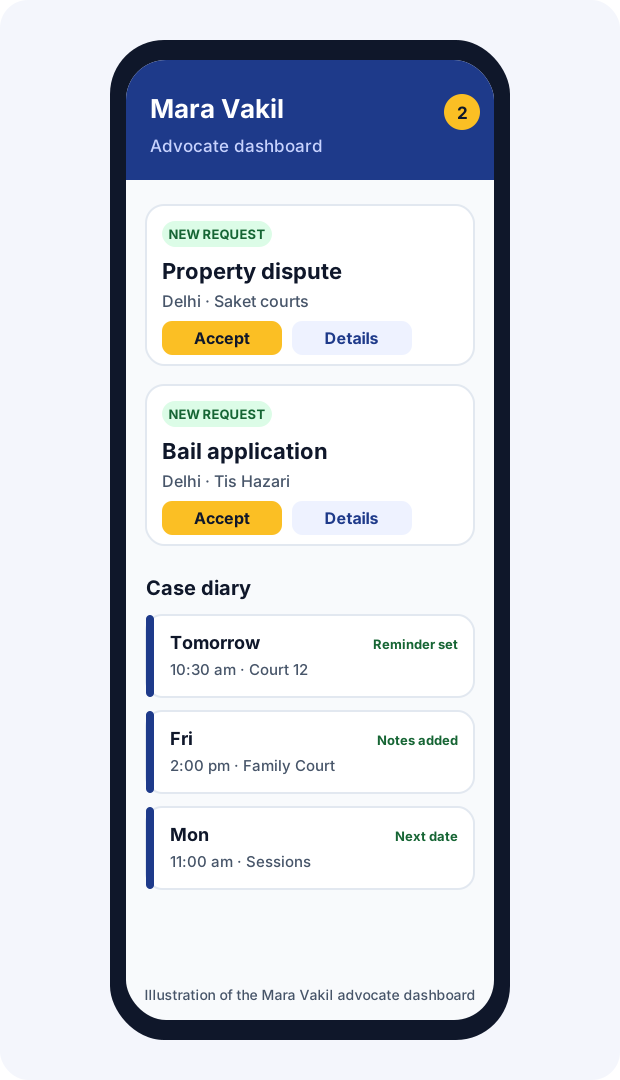
New client requests in your areas and city, newest first. Open one to read the full description, then accept or leave it.
The case diary: every case with its court, number and dates. Add cases from accepted requests or by hand, and write a note after each hearing.
Hearing reminders one day before and on the day, shown inside Mara Vakil and on your phone once you allow notifications.
The Mara Vakil groups for the courts you practise in, with notices from the group.
Post internship openings and review applications from law students.
Messages from the Mara Vakil team, sometimes with a picture, and alerts about new requests. The bell shows how many are unread.
The client has already written down their problem, so the call starts further along than a cold enquiry. It still decides whether they engage you. A simple structure helps.
| Matter | Ask for |
|---|---|
| Bail or police notice | FIR number, police station, sections, date and time of arrest or notice, next court date |
| Divorce or maintenance | Date and place of marriage, children, date of separation, income details, any earlier cases |
| Cheque bounce | Cheque date and amount, date of the bank return memo, whether notice was sent and when |
| Property dispute | Title documents, revenue records, who is in possession, any registered deed or pending case |
| Consumer complaint | Invoice, amount paid, correspondence with the company, date the problem arose |
| Cyber fraud | Transaction IDs, bank and time, complaint number from 1930 or cybercrime.gov.in |
A client who reached you through Mara Vakil is your client in every sense, and all your professional duties apply from the first call.
It helps to see Mara Vakil from the client's side, because that is where your profile does its work.
Every detail on your profile that helps a frightened person feel they have found the right advocate, a court they recognise, a language they speak, a clear photo, matters more than any amount of description.
Since Mara Vakil has no ratings or rankings, clients choose on the things that genuinely matter to them. Talk to people who have been through a legal problem and the same reasons come up.
A calm, prompt call from an advocate who has read their message carefully makes a stronger impression than anything written on a profile.
Clients want someone who knows the court where their case is or will be. "I am in the Tis Hazari courts every day" is reassuring.
Being able to explain their situation in their own language is a relief to many clients, especially older ones.
Clients fear hidden costs. A clear, written fee by stage builds trust quickly.
Some clients prefer a woman advocate, or someone of a certain experience. A clear photo and honest year of enrolment help them choose.
Clients notice when an advocate tells them the weak points of their case. It is often the reason they come back, and send others.
Beyond the short answers in the FAQ, these are the questions advocates most often want to talk through.
Some senior members of the bar are wary of online platforms, often because of directories that sell listings and ratings. Mara Vakil is deliberately different: no ratings, no paid placement, no commission, profiles limited to permitted particulars, and contact started by the client. Many advocates find it easier to explain it as a verified referral desk than as a directory. It is your decision, and you can leave at any time.
Your engagement with the client is a normal professional engagement. Agree fees in writing before you begin significant work, take a reasonable advance where appropriate, and issue receipts. Mara Vakil does not collect fees and cannot recover them, just as a colleague who refers a client to you cannot.
Clients can contact Mara Vakil's support team. We listen to both sides, and most complaints are misunderstandings about fees or updates that a conversation resolves. Serious professional misconduct is a matter for the State Bar Council, as it always is. Profiles that break the listing policy, for example by misrepresenting enrolment, can be suspended or removed.
No. Requests are not a quota, and there is no penalty for leaving matters that are not right for you.
Joining and receiving requests are free at present, and Mara Vakil does not take a commission on the fees you charge. That is the position today, and it is part of the declaration you accept when you apply.
Yes. Many advocates use the diary for all their matters, because the reminders and client notes are useful regardless of where the client came from.
Most advocates know their Bar Council, but a few cover more than one state or union territory, which confuses the dropdown. Here are some of the combinations that cause questions. If in doubt, use the name printed on your ID card or certificate.
| State Bar Council | Covers |
|---|---|
| Bar Council of Maharashtra and Goa | Maharashtra, Goa, and the union territory of Dadra and Nagar Haveli and Daman and Diu |
| Bar Council of Punjab and Haryana | Punjab, Haryana and Chandigarh |
| Bar Council of Tamil Nadu and Puducherry | Tamil Nadu and Puducherry |
| Bar Council of Kerala | Kerala and Lakshadweep |
| Bar Council of West Bengal | West Bengal and the Andaman and Nicobar Islands |
| Bar Council of Delhi | The National Capital Territory of Delhi |
| Bar Council of Uttar Pradesh | Uttar Pradesh, including advocates practising at Allahabad and Lucknow |
Telangana and Andhra Pradesh, Bihar and Jharkhand, Madhya Pradesh and Chhattisgarh, and Uttar Pradesh and Uttarakhand each have separate Bar Councils now. If you enrolled before a state was divided, your card may carry the older name; choose the Bar Council where your name currently stands and tell our team if the card differs.
These are composite examples based on common situations, not real advocates. They show how the details on the form shape what happens next.
Enrolled eight months ago, she works mornings in a senior's chamber and has started taking small matters of her own. She ticks Cheque Bounce, Consumer Protection and Documentation & Notary, lists the Jaipur district courts and the consumer commission, and adds Hindi, English and Rajasthani. Her first requests are a cheque bounce notice and a consumer complaint against a builder. She speaks to her senior before accepting, keeps her fees clear and modest, and uses the diary so she never misses a date while juggling chamber work.
Twelve years in practice, mostly before the Motor Accident Claims Tribunal and the consumer commissions. His first application is delayed because he selected the wrong Bar Council for an old enrolment number; a two-minute call sorts it out. He chooses only Motor Accident Claims, Consumer Protection and Banking & Finance, so he sees fewer requests, but almost all are matters he wants.
She handles maintenance, domestic violence and custody cases and wants to reach women who would not walk into a chamber full of strangers. She lists the family courts and the Alipore court complex, adds Bengali, Hindi and English, and writes a short factual summary. Many of her requests come late in the evening from women who have read the family law guide; she replies the next morning and fixes calls at times when the client can speak privately.
He transferred his enrolment to the Bar Council of Delhi but his old ID card still shows Uttar Pradesh. He selects Delhi, enters the number the Delhi Bar Council recognises, uploads both the old card and his transfer certificate as a single PDF, and mentions the transfer in the call. He lists the Karkardooma and Tis Hazari courts and the Delhi High Court, and his requests now come from Delhi rather than Lucknow.
Not every advocate is comfortable filling forms on a phone, and that is no reflection on their practice. Some of the most experienced advocates in district courts still keep a paper diary and let a clerk handle the phone. If that sounds like you, here are some easy ways to get registered.
The most common cause is file size. The enrolment document must be under 5 MB and the photo under 2 MB. Try reducing the image size from your gallery, taking a fresh photo in better light at a lower resolution, or saving the document as a PDF from a scanning app. Files must be JPG, PNG or, for the enrolment document, PDF. If it still fails, try another browser or call us.
Check that the number is correct and has signal, wait a minute and request it again. Some phones filter messages from unknown senders, so check the spam or promotions folder of your messaging app.
Open the Join as an Advocate page and complete four short screens: your details with OTP verification, your enrolment details with a photo or PDF of your Bar Council ID card or Certificate of Enrolment, your practice areas, courts and languages, and a review page with four declarations. Our team checks your enrolment and, once approved, the admin gives you a login ID and password.
Yes. Applying, being listed, receiving client requests and using the practice tools are free at present. There is no plan, subscription or per-request charge, and Mara Vakil takes no commission on your fees.
Yes. The form is designed for phones. Keep a clear photo or PDF of your Bar Council ID card or Certificate of Enrolment ready and it takes about five minutes.
Your enrolment number and year, your State Bar Council, and a photo or PDF of your Bar Council ID card or Certificate of Enrolment, as a JPG, PNG or PDF under 5 MB. A profile photo, as a JPG or PNG under 2 MB, is optional.
Most applications are reviewed within a few working days. Our team checks your enrolment against State Bar Council records and may call you. You can check the status any time with your application ID and mobile number.
Yes, as long as your provisional enrolment is valid and you are entitled to practise. If you have passed the All India Bar Examination, add your AIBE certificate number to help verification.
Yes. Advocates can register from the day they are enrolled. Your year of enrolment appears on your profile, so clients see your experience honestly.
Choose the Bar Council on whose roll you currently stand and enter the enrolment number it recognises. Mention the transfer when our team calls if your ID card still shows the earlier Bar Council.
The form does not accept words such as best, top, number one, guarantee, 100 per cent, success rate or win, because the Bar Council rules do not allow advocates to advertise. Write a short factual summary of your courts, practice areas and languages instead.
There is no fixed limit, but three to six areas you handle regularly usually work best. Requests are matched to the areas you choose, so avoid ticking areas you would not want to receive.
Yes. Add every court, tribunal or commission where you regularly appear, including the High Court if you practise there.
Requests from clients in your city in the practice areas you chose appear on your dashboard, with an on-screen alert and an optional sound when you are logged in, and phone notifications if you allow them. You see the matter and the city; the client's number appears once you accept.
No. Accept only matters that suit your practice and time. Requests you leave remain available to other advocates, and there is no penalty.
Yes. Your fee is discussed and agreed directly with the client and paid to you directly. Mara Vakil does not set, collect or share in your fees, and profiles do not display fees.
Mara Vakil was designed around the concerns raised by the courts and the Bar Council of India: profiles carry only permitted particulars, there are no stars, rankings or paid upgrades, advocates pay nothing and share no fees, and clients start the contact. The wider legality of online listings is still before the Supreme Court, so each advocate should satisfy themselves after reading our Rule 36 guide.
No. Enrolment with a State Bar Council is your legal right to practise. Mara Vakil registration is a checked profile on a platform where clients describe their matters, and it requires that you are already enrolled.
Not if your employment requires you to suspend practice under the Bar Council rules. Mara Vakil is for advocates who are entitled to practise.
No, only enrolled advocates can be listed. Law students can find and apply for internships through the Intern Hub.
Mara Vakil lists individual advocates. Advocates in a firm can each apply with their own enrolment and practice details, subject to their firm's policy.
Your number is shared with a client when you accept their request so that you can speak to them. Your enrolment documents are never shown publicly.
Call the Mara Vakil team on 98913 43962. After confirming your identity, the admin will set a new password for you.
Yes. Update your profile as your practice changes so that requests stay relevant to you.
Yes. Ask us to deactivate it at any time and it will be taken off the public directory.
No. Mara Vakil never asks advocates for money to join, activate a profile or unlock client requests. Do not pay, and report the call to our team on 98913 43962.
Free to join. No commission. Enrolment checked. Client requests in your practice area and city.
This page gives general information as of 14 October 2026. It is not legal advice and is not an advertisement or solicitation by any advocate. Mara Vakil is a technology platform, not a law firm. Each advocate is responsible for complying with the Advocates Act, 1961 and the Bar Council of India Rules. Read our Advocate Listing Policy and disclaimer.
Free, enrolment-checked profile. Client requests in your practice area, no commission on your fees, a free case diary and your court group. Apply in about 10 minutes.