
What the rule says, what the 2008 amendment allows, what the Madras High Court and the Bar Council of India have said about online directories and social media, and a quick self-check before you post or list anywhere.
Rule 36 sits in Part VI, Chapter II of the Bar Council of India Rules, the chapter that lays down standards of professional conduct and etiquette for advocates. The Bar Council of India frames these rules under Section 49(1)(c) of the Advocates Act, 1961, and the State Bar Councils enforce them through their disciplinary committees.
In substance, the rule says that an advocate shall not solicit work or advertise, either directly or indirectly. It then lists the forbidden methods: circulars, advertisements, touts, personal communications or interviews not warranted by personal relations, furnishing or inspiring newspaper comments, and producing photographs to be published in connection with cases in which the advocate has been engaged or concerned. The rule also limits sign-boards and name-plates to a reasonable size and says they should not indicate that the advocate is or was the president or a member of a bar council, a judge, or associated with any person or organisation, or that the advocate specialises in any particular kind of work.
In 2008, while a challenge to the rule was being heard by the Supreme Court in a petition filed by advocate V.B. Joshi, the Bar Council of India amended Rule 36 to allow advocates to furnish information on websites. The information must be limited to prescribed particulars and is the advocate's responsibility. Reports of the amendment and later practice describe the permitted particulars broadly as:
Anything beyond these, especially anything that praises, compares, promises or invites, takes the advocate back into the territory the rule prohibits. Publishing extra particulars has been described as a violation of Rule 36 itself.
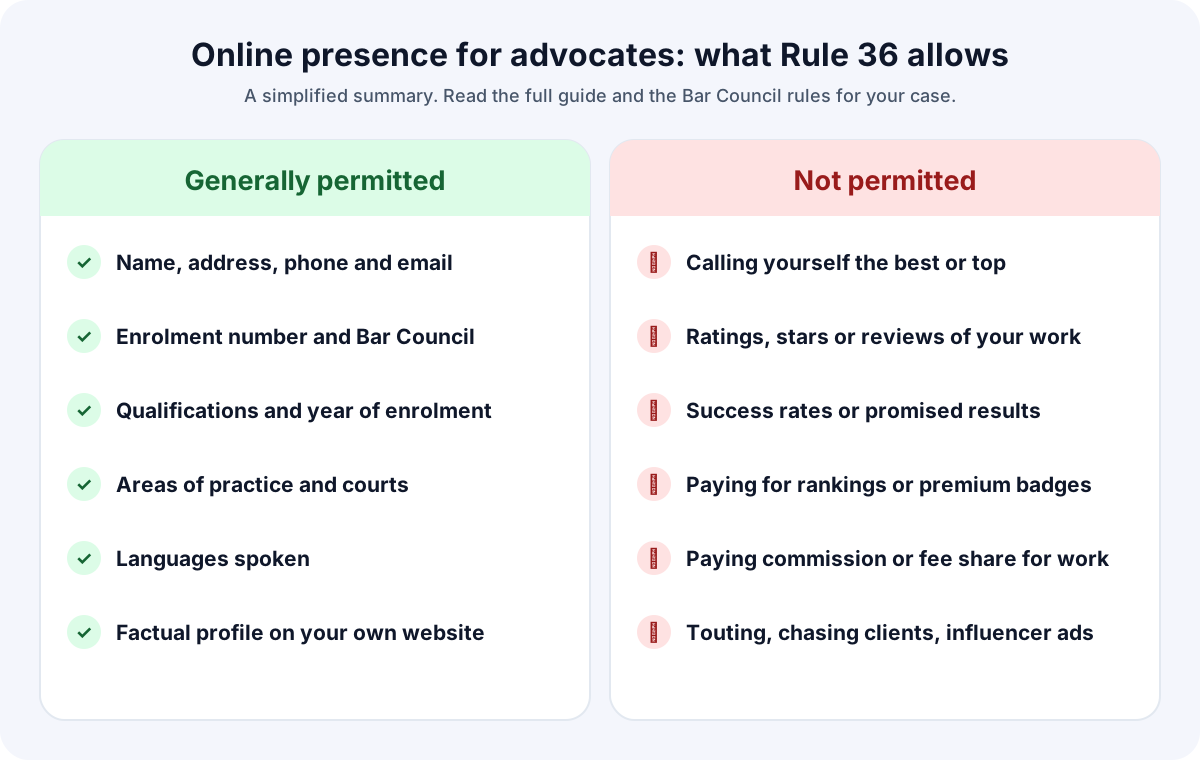
Rule 36 is not a guideline or a matter of etiquette alone. It is a rule framed under statutory power, and breaking it carries statutory consequences.
| Provision | What it does |
|---|---|
| Section 49(1)(c), Advocates Act, 1961 | Empowers the Bar Council of India to make rules on standards of professional conduct and etiquette. |
| Section 35, Advocates Act | Allows a State Bar Council's disciplinary committee to punish professional or other misconduct by reprimand, suspension or removal from the roll. |
| Section 36, Advocates Act | Gives the Bar Council of India's disciplinary committee powers in certain cases, including transferring proceedings. |
| Section 37 and 38, Advocates Act | Provide appeals from a State Bar Council's disciplinary committee to the Bar Council of India, and from there to the Supreme Court. |
| Rule 36, BCI Rules | Prohibits soliciting work and advertising, with the website proviso added in 2008. |
A complaint about advertising can be made by a client, another advocate, a bar association or the Bar Council itself. The disciplinary committee issues notice, hears the advocate and decides. Even a reprimand stays on the advocate's record, and suspension stops practice altogether for the period.
The rule rests on an old idea: that law is a profession practised in the service of justice, not a trade carried on for profit. Indian courts have repeated this for more than half a century.
| Decision | What it said, in short |
|---|---|
| C.D. Sekkizhar v. Secretary, Bar Council (Madras High Court) | Treated advertising by lawyers as improper and inconsistent with the profession. |
| Bar Council of Maharashtra v. M.V. Dabholkar (Supreme Court, 1976) | Described the Bar as a noble profession and condemned soliciting work through touting as conduct unworthy of it. |
| Bar of Indian Lawyers v. D.K. Gandhi (Supreme Court, 2024) | Held that services of advocates are not covered by the Consumer Protection Act, describing the legal profession as sui generis, different from ordinary trades. |
| P.N. Vignesh v. Bar Council of India (Madras High Court, 2024) | Said customer ratings and rankings of lawyers demean the profession and that intermediaries facilitating such advertising cannot shelter behind the IT Act. |
The practical concerns behind the rule are easy to understand. People with legal problems are often frightened and vulnerable. Legal services are hard to judge in advance, so claims of being "the best" or of "guaranteed bail" cannot be checked and invite exaggeration. If advocates competed on advertising budgets, money rather than ability might decide who gets work. And paying others to bring clients, whether touts, agents or platforms, corrupts the trust between advocate and client.
Critics argue that the rule now does more harm than good. Clients, they say, have a right to information when choosing a lawyer; the rule protects established advocates with family networks and disadvantages first-generation lawyers in smaller cities; and other professions and other countries allow regulated marketing. The Supreme Court itself, in Tata Press Ltd. v. Mahanagar Telephone Nigam Ltd. (1995), recognised commercial advertising as speech protected under Article 19(1)(a), subject to reasonable restrictions. A high-level committee on competition policy also argued in the past for liberalising professional advertising. Those arguments are now before the Supreme Court in the matters described below.
| When | What happened |
|---|---|
| 1961 | The Advocates Act creates the Bar Council of India and the State Bar Councils and gives them power over professional conduct. |
| 1975 onwards | The Bar Council of India Rules, including Rule 36, prohibit advertising and solicitation. |
| 1976 | In M.V. Dabholkar, the Supreme Court condemns touting and stresses the profession's public character. |
| 1995 | In Tata Press, the Supreme Court recognises commercial advertising as protected speech, a decision often cited by those who want Rule 36 relaxed. |
| 2008 | During the V.B. Joshi petition in the Supreme Court, the Bar Council of India amends Rule 36 to permit websites with prescribed particulars. |
| 2014 | The Bar Council of India indicates that law firms too may have websites within the permitted particulars. |
| 3 July 2024 | The Madras High Court, in P.N. Vignesh, holds that directory listings of lawyers with ratings and "premium" labels facilitate unlawful advertising and directs the Bar Council of India to act. |
| July 2024 | The Bar Council of India directs State Bar Councils to start disciplinary proceedings against advocates advertising or seeking work through online portals and sends notices to several directory websites. |
| November 2024 | The Supreme Court issues notice to the Bar Council of India on an appeal by a directory platform about whether listings with only permitted information breach Rule 36. A separate appeal by another platform is also pending. |
| 17 March 2025 | The Bar Council of India warns against celebrity and influencer promotion, promotional stalls and banners, and unqualified "legal influencers". |
| 4 August 2025 | The Bar Council of Delhi issues a notice treating soliciting work through social media, including promotional videos, as unethical canvassing, and warns of action under Section 35. |
| 14 July 2026 | The Supreme Court issues notice on a public interest petition, Anil Pandey v. Bar Council of India, seeking enforcement of Rule 36 against digital solicitation and a code of digital conduct for advocates, and later seeks responses from State Bar Councils. |
As we write this in October 2026, none of the Supreme Court matters has been finally decided as far as we know. Check the latest position before relying on any reading of the law.
The case began as a public interest petition by an advocate, P.N. Vignesh, who complained that well-known directory and classifieds websites were listing lawyers, often without their consent, assigning them ratings and offering paid labels such as "platinum", "premium" or "top service provider". The respondents included the Bar Council of India, the Bar Council of Tamil Nadu and Puducherry, and the websites themselves.
A Division Bench of Justices S.M. Subramaniam and C. Kumarappan agreed with the petitioner on the main points:
The judgment did not say that every mention of a lawyer online is illegal. Its target was the commercial model of ranking and selling visibility. That distinction is exactly what the platforms' appeals ask the Supreme Court to clarify.
Following the Madras judgment, the Bar Council of India issued directions and a press release. In summary, it asked State Bar Councils to:
It also sent notices to several directory websites asking them to remove lawyer listings, profiles and advertisements, and said that some had collected lawyers' data and listed them without their knowledge. The press release used words that capture the Council's view: legal service is "neither a job nor a business", and the object of the legal profession is justice, not profit.
At least two platforms have challenged the Madras judgment in the Supreme Court. In November 2024 the Court issued notice to the Bar Council of India on one appeal, which asks whether third-party platforms breach Rule 36 when they publish only the information the rules permit. The platforms argue that the High Court's reading could make it impossible for advocates to have any online presence and for people to find lawyers. The Bar Council's position is that listing and ranking lawyers commercially is touting.
On 14 July 2026, a bench of Chief Justice Surya Kant and Justices Joymalya Bagchi and V. Mohana issued notice on a writ petition, Anil Pandey v. Bar Council of India. The petition asks the Court to direct strict enforcement of Rule 36 and the dress rules; to declare that promotional reels, influencer collaborations and monetised legal content are misconduct; to ban promotional filming in court premises; to have the Bar Council of India issue digital ethics guidelines under Section 49 of the Advocates Act; and to set up an expert committee to draft a model code of digital professional conduct. The Court later sought responses from State Bar Councils as well.
In June 2026 the Court also issued notice on a petition by the Bar Association of India seeking a national digital registry of advocates with verifiable enrolment status and disciplinary records, together with a digital conduct code. Read with the July petition, it suggests the Court is looking at online conduct and verification together: how people can find genuine lawyers online without the profession sliding into commercial promotion.
The Court could uphold the present rule and ask the Bar Council to enforce it more strictly online; it could ask the Bar Council to frame detailed digital guidelines, clarifying what is permitted; or it could push for a regulated middle path that allows truthful information while forbidding misleading claims, rankings and paid touting. Commentators have pointed to all three possibilities. Until then, advocates should follow the rule as it stands.
Law firms face the same rule as individual advocates, because their partners and associates are advocates bound by the Bar Council rules. Practice in India has settled into some common patterns.
The draft Advocates (Amendment) Bill released by the Bar Council of India for comments in July 2026 proposed formal legal recognition for law firms. If such changes are enacted, rules on firm communications may also be revisited. Read our news report on the draft Advocates (Amendment) Bill 2026.
Not all platforms are the same, and the risk under Rule 36 depends heavily on the model.
| Model | Typical features | Risk under Rule 36 |
|---|---|---|
| Classified or directory listing | Paid tiers, ratings, reviews, badges, sometimes listing without consent | High; this was the model criticised in 2024 |
| Lead marketplace | Advocates buy enquiries, often sold to several advocates | High; resembles paying for work |
| Service marketplace | Platform sells a legal service at a fixed price and pays the advocate a share | High; client belongs to the platform and fee sharing concerns arise |
| Client-initiated, free, particulars only | Client describes the matter; checked advocates choose to respond; no fee, no commission, no ratings | Lower, but the general question of listings is still before the Supreme Court |
Software that helps advocates run their practice, such as case diaries, hearing reminders, research databases, e-filing aids and document management, does not raise Rule 36 concerns at all, because it does not present the advocate to the public. Concern arises only when a tool also publishes advocates to clients, and then the usual questions apply: what the profile shows, whether advocates are rated or ranked, whether anyone pays for visibility or work, and who starts the contact. When evaluating a product, separate the practice-management features from any public-facing directory and judge each on its own terms.
Our separate checklist for advocates considering a platform sets out the questions to ask.
Mara Vakil was built after studying the Madras High Court judgment and the Bar Council's directions. We cannot promise the outcome of pending cases, and nothing here is legal advice, but these are the choices we made and why.
| Concern raised by courts and the Bar Council | What Mara Vakil does |
|---|---|
| Ratings and reviews of advocates | None. Profiles carry no stars, scores or reviews. |
| Labels like "premium", "platinum", "top" | None. The only badge states that enrolment was checked. |
| Paid placement and ranking | None. Advocates cannot pay to appear higher. |
| Information beyond permitted particulars | Profiles show name, enrolment, courts, practice areas, languages, and optional qualifications, address, short factual summary and photo. The join form rejects words such as best, top, guarantee and success rate. |
| Listing lawyers without consent | Only advocates who apply and are approved are listed. |
| Paying for work and fee sharing | No joining fee, no per-request charge and no commission on fees. |
| Soliciting clients | The client describes the matter and starts the contact; advocates only respond. |
| Fake or unqualified practitioners | Each enrolment is checked against State Bar Council records before the profile goes live. |
Every advocate should still make their own judgement and read our Advocate Listing Policy. If you decide Mara Vakil fits within your obligations, our registration guide explains the steps.
This table is our reading of the rule, the orders and the notices described above, for general guidance only. Your State Bar Council's view is what counts.
| Situation | Our reading |
|---|---|
| Your own website with name, contact, enrolment, bar association, qualifications and practice areas | Permitted since 2008 |
| Website saying "best divorce lawyer in Delhi", with testimonials or success rates | Not permitted |
| Visiting card with factual particulars | Normal professional practice |
| Name-plate saying "Former Judge" or "Specialist in bail" | Rule 36 discourages such indications on sign-boards |
| Email signature with your name, enrolment and contact | Generally fine |
| WhatsApp status advertising your services to all contacts | Solicitation by personal communication |
| Bar association directory listing members' contact details | Generally accepted as a professional directory |
| Map or business listing that collects public star ratings | Risky because of ratings; keep it factual if you have one |
| Paid search engine advertisements for your services | Advertising |
| Newspaper interview about a legal reform, without mentioning your cases | Generally accepted; avoid promoting yourself |
| Newspaper story about your client's case, with your photograph | Specifically covered by Rule 36 |
| Articles in law journals or newspapers explaining the law | Generally accepted; avoid self-promotion in them |
| Speaking at a legal literacy camp organised by a legal services authority | Public service; do not hand out cards or invite clients |
| Profile on a platform with only permitted particulars, no ratings, no fee | Lower risk; general question pending in the Supreme Court |
| Paying a platform for a premium badge, top placement or leads | High risk |
| Platform that takes a percentage of your fee | High risk; resembles fee sharing |
| Short videos explaining the law, with no call to hire you | Grey area; watch your Bar Council's notices |
| Videos about your own wins, or filmed in court in robes | Not permitted |
| Influencer or celebrity promotion | Not permitted |
| Sponsoring a community event with a banner naming your practice | The Bar Council of India called this unethical canvassing in 2025 |
A simple, factual website is the one form of online presence the rule clearly allows. It is also useful: people who hear your name from a relative or colleague can confirm you are genuine and find your chamber.
| Section | Include | Leave out |
|---|---|---|
| Home | Name, enrolment details, place of practice, a disclaimer notice | Slogans, "best", "leading", photos with celebrities |
| About | Qualifications, year of enrolment, courts where you practise, bar association membership | Awards, rankings, client lists |
| Practice areas | A plain list of areas | "Specialist", success rates, "100 per cent results" |
| Contact | Chamber address, phone, email, hours | Pop-up "chat with a lawyer now" prompts aimed at the public |
| Articles | General legal explanations, if you publish them | Stories of your cases, calls to hire you |
A useful habit is to read your own site once a quarter as a stranger would. If any sentence sounds like a sales pitch rather than a statement of fact, rewrite or remove it. Ask a colleague to do the same; others notice promotional tone more easily than we do in our own words.
Keep the site current and accurate, since the advocate is responsible for what it says. Avoid tracking pop-ups or chatbots that approach visitors with offers of service.
Complaints about advertising usually begin with a letter from the State Bar Council asking for your response. Take it seriously.
| Country | General position |
|---|---|
| India | Advertising and soliciting prohibited; limited factual website particulars allowed since 2008. |
| United States | In Bates v. State Bar of Arizona (1977) the Supreme Court held truthful lawyer advertising is protected speech. State rules modelled on the American Bar Association's model rules prohibit false or misleading communications and restrict in-person solicitation. |
| England and Wales | Solicitors and barristers may publicise their services subject to their regulators' rules. Since 2018, many solicitors' firms must publish price and service information for certain kinds of work. |
The comparison cuts both ways. Supporters of reform say Indian clients deserve similar information. Supporters of the rule point to India's large number of unrepresented, vulnerable litigants and the risk of aggressive marketing to them.
A middle path discussed by some members of the Bar would allow truthful, verifiable information about qualifications and practice areas, while disciplining misleading claims, success rates, rankings and paid touting. Whatever the Supreme Court and the Bar Council decide, verification of who is genuinely an advocate is likely to matter more, not less.
The rule was written long before smartphones, but each of its clauses maps onto things advocates are tempted to do today. Reading it clause by clause makes the boundaries clearer.
This is the core prohibition, and the word "indirectly" is what gives it reach. It catches promotion that does not look like an advertisement: a carefully staged news story, a "client appreciation" post, a sponsored legal awareness banner carrying your name, or a reel that ends with your number. The question is the substance, not the label.
Leaflets, posters, newspaper and radio advertisements, paid social media promotions, sponsored search results and bulk messages all fall here. Whether the medium is paper or digital makes no difference.
A tout procures clients for an advocate, usually for a payment or a share of fees. The modern equivalents include agents who hang around courts, call centres that sell enquiries, and any arrangement where someone is rewarded for steering clients to you. Paying for "leads" can amount to the same thing.
Approaching people who are not your relatives, friends or existing clients to offer your services is solicitation. Today that includes unsolicited WhatsApp messages, cold calls to accident victims' families, direct messages on social media to people who posted about a legal problem, and visiting hospitals or police stations to offer services. Telling your own colleagues, friends and family what you do is a personal communication warranted by personal relations.
Planting stories about your cases or yourself in the press, or arranging for coverage that praises you, is forbidden. Commenting on legal developments in general terms, without promoting yourself or your matters, is generally accepted in practice.
Photographs with clients after a judgment, pictures outside court posted with the case name, and their video equivalents are all within this clause. The concern about promotional videos shot in court premises in robes is a natural extension of it.
The rule asks that these be of reasonable size and not indicate past office in a bar council or association, a past judicial post, association with particular persons or causes, or specialisation in a type of work. A plain board with your name and "Advocate" remains the standard.
The 2008 addition allows information on a website within the prescribed particulars. It is an exception to the general rule, so it is read narrowly: if information falls outside the list, it is treated as advertising.
Court dress for advocates is governed by the Bar Council of India's rules on dress, which prescribe the black coat or jacket, white bands and, in certain courts, the gown. The dress signals the advocate's role as an officer of the court. The 2026 petition before the Supreme Court specifically objects to robes and bands being worn in promotional social media content and to filming in court premises, and the Supreme Court Advocates-on-Record Association raised concerns in 2025 about reels filmed in the Supreme Court's high-security areas. Whatever the final outcome, using court dress or court buildings as a backdrop for self-promotion invites trouble.
A theme that runs through the debate is trust. If people cannot rely on advertising to choose a lawyer, they at least need to know that the person in front of them is a genuine advocate. In June 2026, the Supreme Court issued notice on a petition by the Bar Association of India seeking a national digital registry of legal professionals, with a unique identifier for each advocate, real-time enrolment status, verified qualifications and disciplinary records, and a social media code of conduct for advocates. The bench described the idea as innovative and listed it for further hearing.
Verification is something every platform and every client can do now. Mara Vakil checks each advocate's enrolment against State Bar Council records before a profile goes live, and clients can ask any advocate for their enrolment number and verify it with the Bar Council.
First-generation advocates feel Rule 36 most sharply. Without family networks, they need people to know they exist. A few approaches stay on the right side of the line.
Our guide on how advocates get clients in India covers these approaches in detail.
These composite scenarios show how the rule applies to common situations. They are illustrations, not rulings.
A Delhi advocate posts weekly videos explaining new criminal law provisions, recorded in her office, with no mention of her cases and no contact details beyond her name. This is educational and widely tolerated, though it falls in the area the 2026 petition asks the Court to examine. Adding "DM me for bail" at the end would turn it into solicitation.
An advocate films himself in robes on the court corridor announcing that he "got bail in 24 hours" for a client. Several problems at once: a claim about results, content about a client's case, promotional use of court dress and premises. This is the kind of content Bar Councils have asked advocates to remove.
A directory offers an advocate a "verified gold" badge and top position in search results for a monthly fee. Paying for ranking and badges is the model the Madras High Court criticised. High risk.
A law firm posts on LinkedIn that its partners advised a named company on a large acquisition. Common in corporate practice, but it is indirect advertising, and the safer course under the current rule is to avoid it or keep such information to factual, client-approved disclosures where legally required.
A woman describes her maintenance problem on a platform; the request goes to checked family lawyers in her city; one accepts and calls her. The advocate paid nothing, is not rated or ranked, and did not approach her. This model avoids the features courts have objected to, though the broader question of listings is still pending.
Much confusion comes from treating every mention of a lawyer as advertising. The rule actually draws three different lines.
| Information | Advertising | Solicitation | |
|---|---|---|---|
| What it is | Neutral facts that let people identify and verify an advocate | Promotion addressed to the public to attract work | Seeking work from particular people, directly or through others |
| Examples | Name, enrolment, qualifications, practice areas, address | "Best lawyer" banners, paid posts, success-rate claims | Cold calls to accident victims, touts at courts, unsolicited messages |
| Position under Rule 36 | Permitted within the 2008 particulars | Prohibited, directly or indirectly | Prohibited |
| Typical medium | Website, name-plate, visiting card, factual profile | Ads, sponsored content, promotional videos | Phone, messages, agents, hospital or police station visits |
The Madras High Court's judgment is often described as a ban on lawyers being online. It is narrower than that.
Whether on your own website or a platform, the words you choose matter. These examples show the difference.
| Permitted style | Not permitted style |
|---|---|
| "Enrolled with the Bar Council of Delhi in 2016. Practises at the Saket District Courts." | "Delhi's leading criminal lawyer." |
| "Areas of practice: family law, maintenance, domestic violence." | "Specialist with 100 per cent success in divorce cases." |
| "LL.B., University of Delhi; LL.M., National Law University." | "Award-winning, top-ranked advocate." |
| "Languages: Hindi, English, Punjabi." | "Cheaper and faster than other lawyers." |
| "Chamber 210, Lawyers' Block, Saket Courts." | "Call now for guaranteed bail." |
Advocates are often asked by reporters to explain a judgment or a new law. The rule forbids furnishing or inspiring newspaper comment to promote yourself, not public discussion of the law.
Teaching law students, speaking at seminars and conducting legal literacy sessions for legal services authorities are long-standing parts of professional life and are not prohibited. Keep three habits: speak about the law rather than your practice; do not distribute visiting cards or invite audience members to consult you; and when organisers print your name, keep it to your name, enrolment and perhaps your court or institution. Where a seminar is organised by a commercial sponsor, be careful that your name is not used to promote the sponsor's legal services.
Everyday stationery rarely causes trouble if it stays plain. A typical compliant visiting card or letterhead carries:
Avoid logos that suggest an organisation you are not part of, past offices, phrases such as "specialist" or "expert", and slogans. In emails, a signature with the same particulars is fine; promotional banners in signatures are not.
Concern about lawyers chasing work is older than the Advocates Act. The Legal Practitioners Act, 1879, which governed pleaders and vakils in British India, gave courts power to frame and publish lists of touts and to exclude them from court precincts. Touting was seen as a corruption of the courts themselves: people who loitered near courts and police stations steering litigants to particular pleaders for a cut.
After independence, the Advocates Act, 1961 unified the profession and placed the power to set conduct standards with the Bar Council of India. The Bar Council's rules, framed in 1975, carried forward the prohibition on soliciting and advertising in Rule 36. For three decades the rule was read strictly; even a modest brochure or a newspaper notice of a new chamber could invite trouble.
The internet forced the first change. By the 2000s, firms abroad had websites, Indian clients expected to find lawyers online, and advocates challenged the rule in the Supreme Court. The 2008 proviso was a compromise: a website, but only with neutral particulars. A decade and a half later, the rise of directories, lead sellers and social media influencers brought the question back, this time to the Madras High Court in 2024 and to the Supreme Court in 2024 and 2026. The underlying tension has not changed: how to let people find a lawyer without turning the profession into a marketplace of claims.
The legal profession is not alone in restricting promotion. Other regulated professions in India have rules of their own, which are useful for comparison, though each has its own details and changes over time.
| Profession | General approach |
|---|---|
| Chartered accountants | The Institute of Chartered Accountants of India restricts solicitation and advertising by members, while permitting websites and certain information within its guidelines. |
| Doctors | Medical regulators have long restricted self-promotion by doctors. New professional conduct regulations issued by the National Medical Commission in 2023, which addressed social media and advertising among other things, were kept in abeyance soon after they were notified. |
| Company secretaries and cost accountants | Their institutes similarly restrict advertising and solicitation, with guidelines on websites and directories. |
The common thread is that professions dealing with people at vulnerable moments limit marketing, while allowing factual information that helps people find and verify a professional.
The rule is meant to protect clients, but it also has costs for them, and it is worth being honest about both.
Verified, client-initiated services and better public information about legal aid are ways to narrow those gaps without abandoning the protections the rule provides.
Many advocates discover that a directory or classifieds site has created a profile in their name, often with ratings, a phone number and sometimes a "premium" label, without ever asking them. The Bar Council of India's 2024 notices specifically complained about platforms collecting lawyers' data and listing them without their knowledge. Because you are responsible for how you present yourself, it is wise to act.
An advocate is not only a service provider to a client but also an officer of the court, with duties to the court, to opponents and to colleagues that sometimes outweigh the client's wishes. Promotion pulls against these duties in subtle ways. An advocate who has advertised quick results feels pressure to deliver them, which can tempt shortcuts with the court. Public boasting about wins can embarrass judges and opponents and damage the trust the system depends on. And an advocate competing for attention online may be tempted to comment on pending matters, which risks prejudicing proceedings. Seen this way, Rule 36 is less about modesty than about protecting the integrity of the work itself.
Each State Bar Council follows the procedure in the Advocates Act and its own rules, but the broad course of a misconduct complaint is similar everywhere.
| Stage | What usually happens |
|---|---|
| Complaint | A client, advocate, association or the Bar Council itself raises the matter, often with screenshots or copies of the material. |
| Preliminary scrutiny | The Bar Council considers whether there is a prima facie case and may ask the advocate for comments. |
| Reference to disciplinary committee | If there is reason to believe misconduct occurred, the matter goes to a disciplinary committee under Section 35. |
| Hearing | The advocate receives notice, can file a reply, produce evidence and be heard, personally or through counsel. |
| Decision | The committee may dismiss the complaint, reprimand the advocate, suspend practice for a period, or order removal from the roll. |
| Appeal | An appeal lies to the Bar Council of India under Section 37 and then to the Supreme Court under Section 38. |
Promptly removing doubtful content and responding respectfully are usually wise, whatever you believe about the merits.
Because advocates in India cannot advertise, clients sometimes find it hard to know whom to trust. A few points help.
Advocates may have a website with permitted particulars. Factual profiles are close to that exception, though the position of third-party listings is still before the Supreme Court.
Rule 36 covers indirect advertising too. A free reel inviting people to call you is still solicitation.
It is usually tolerated, but content that ends with an invitation to hire you, discusses your own cases or is filmed in court for promotion crosses the line.
Since 2024 the Bar Council of India and State Bar Councils have issued directions and notices, and the Supreme Court is actively considering the issue.
Lawyers in firms are advocates bound by the same rules.
Yes. Rule 36 of the Bar Council of India Rules prohibits advocates from soliciting work or advertising, directly or indirectly. Limited factual information on a website has been allowed since 2008.
Soliciting work or advertising through circulars, advertisements, touts, personal communications or interviews not warranted by personal relations, inspiring newspaper comments, or publishing photographs connected with cases. It also limits what sign-boards and name-plates may say.
Yes. Since the 2008 amendment, an advocate may have a website with prescribed particulars such as name, contact details, enrolment details, bar association membership, qualifications and areas of practice. Promotional claims, testimonials and results are not allowed.
It can be treated as professional misconduct under Section 35 of the Advocates Act, 1961. A State Bar Council's disciplinary committee can reprimand, suspend or remove the advocate from the roll, with appeals to the Bar Council of India and the Supreme Court.
A factual profile and general legal information are grey areas that are widely tolerated. Promotional videos, content about your own cases, filming in court premises in robes and influencer-style promotion have been specifically warned against.
In 2024 the Madras High Court held that directories listing lawyers with ratings and premium labels facilitate unlawful advertising. Whether listings with only permitted particulars are allowed is pending before the Supreme Court.
It is a 2024 Madras High Court decision on a public interest petition. The court held that platforms rating, ranking and selling premium visibility for lawyers breach Rule 36, that they cannot rely on the IT Act safe harbour, and directed the Bar Council of India to act.
It issued notice on a public interest petition, Anil Pandey v. Bar Council of India, seeking strict enforcement of Rule 36 against digital solicitation, a ban on promotional filming in court premises and a code of digital conduct for advocates, and later sought responses from State Bar Councils.
Paying for clients, leads or premium visibility resembles paying for work and is high risk under the Bar Council rules.
Writing and speaking about the law in general terms is generally accepted. Articles or interviews that promote your services, discuss your clients' cases or carry your photograph in connection with a case are not.
Rule 36 says sign-boards and name-plates should not indicate that an advocate specialises in a particular kind of work. Listing areas of practice on a website under the 2008 proviso is a separate matter.
Many firms do, but it sits uneasily with the prohibition on indirect advertising. The safer course is not to publicise rankings or awards.
No. In Bar of Indian Lawyers v. D.K. Gandhi (2024), the Supreme Court held that advocates' services are not covered by the Consumer Protection Act, describing the profession as sui generis.
It may. The Supreme Court is considering both the platforms' appeals and the 2026 petition on digital solicitation, and some members of the Bar favour a regulated middle path. Until then, the existing rule applies.
Sharing and explaining reported judgments in general terms is common and generally tolerated, as long as you do not use them to promote your services or discuss matters you handled.
Yes. These are professional designations, and the permitted particulars include whether an advocate is a senior advocate. State them plainly, without promotional language.
Rule 36 says sign-boards, name-plates and stationery should not indicate such past offices. Avoid using them to attract work.
A factual listing of your chamber's location is lower risk, but listings that collect public star ratings and reviews raise the same concerns courts have expressed about rated directories.
The rule binds enrolled advocates. Students are not yet advocates, but they should not hold themselves out as lawyers or offer legal services, and the Bar Council of India has criticised unqualified "legal influencers".
A short, factual update about your professional move is close to ordinary information. Avoid adding claims about your expertise, results or clients, and avoid inviting people to send you work.
Stating your profession is factual. It becomes a problem only if the account is then used to promote your services or solicit work.
You cannot control what clients say independently, but you should not ask for reviews, reward them, or republish them, because that turns them into your own advertising.
Record the listing, ask the platform's grievance officer in writing to remove it, keep the correspondence, and if concerned, inform your State Bar Council that you did not authorise it.
Mara Vakil shows only permitted particulars, has no ratings, rankings or paid placement, charges advocates nothing, takes no commission, and lets clients start the contact. The broader question of online listings is before the Supreme Court, so each advocate should decide for themselves.
Through recommendations from people they trust, legal aid services, bar associations and verified, client-initiated services where they describe their matter and checked advocates respond.
Free to join. No commission. Enrolment checked. Client requests in your practice area and city.
This page gives general information as of 14 October 2026. It is not legal advice and is not an advertisement or solicitation by any advocate. Mara Vakil is a technology platform, not a law firm. Each advocate is responsible for complying with the Advocates Act, 1961 and the Bar Council of India Rules. Read our Advocate Listing Policy and disclaimer.
Free, enrolment-checked profile. Client requests in your practice area, no commission on your fees, a free case diary and your court group. Apply in about 10 minutes.
Social media: reels, YouTube, LinkedIn and Instagram
Social media is where most of the current controversy lies. Some advocates have built large followings explaining the law in short videos; others have used the same tools to promote themselves openly, sometimes filming inside court buildings in full robes. The Bar Councils' notices and the 2026 petition draw a line between the two, though the exact position is still being worked out.
A test you can apply
Ask three questions before you post. Would a reasonable viewer understand this mainly as information about the law, or mainly as a reason to hire me? Does it mention my results, my clients or my superiority over others? Does it ask the viewer to contact me for work? If the honest answer to any of these points towards promotion, do not post it.